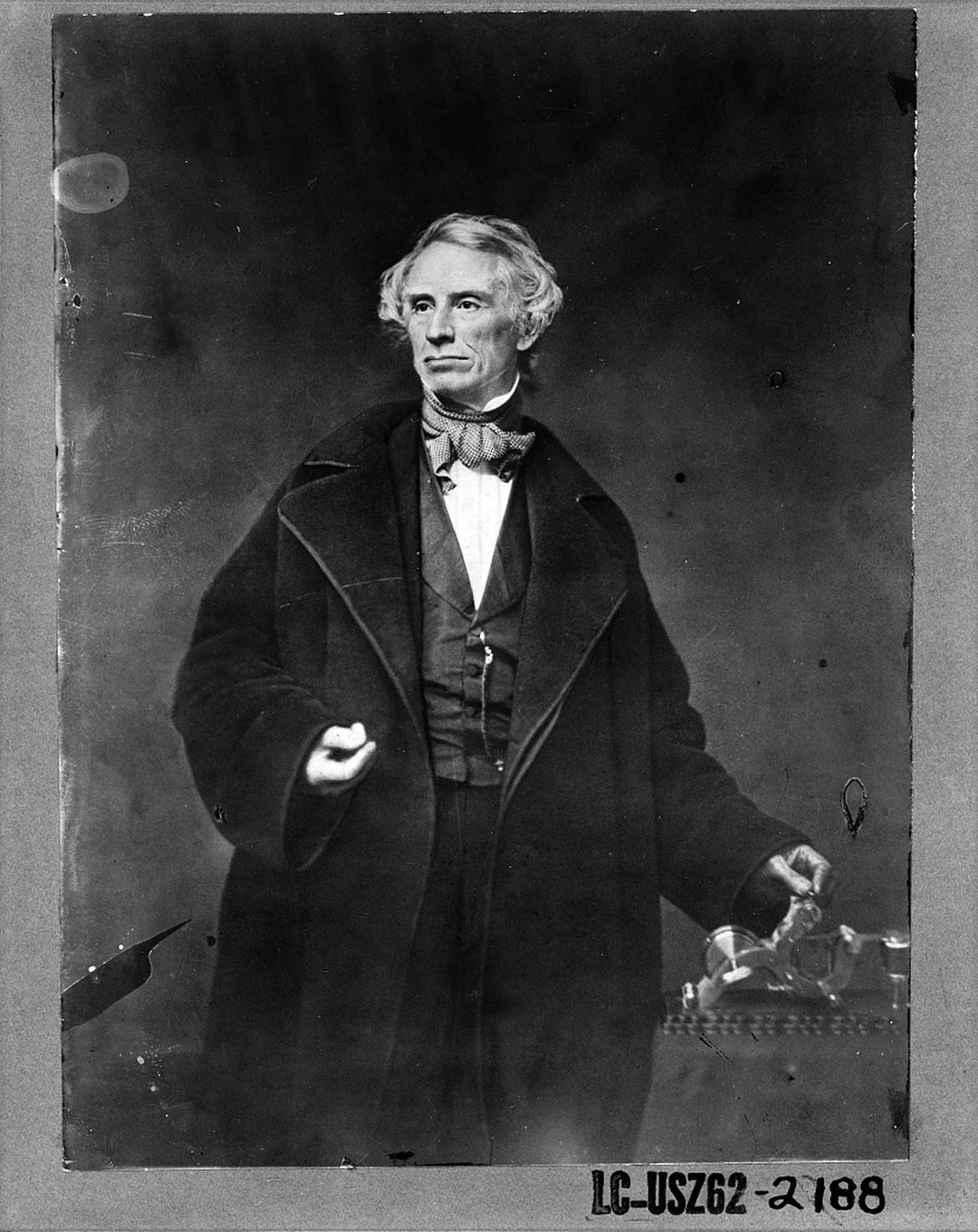
Samuel F. B. Morse
Artist, organizer, inventor, and public advocate associated with the American electromagnetic telegraph.
HISTORY / DOCUMENTARY REFERENCE
FROM THE ARCHIVE

Visual explanation
Four periods mark the code’s movement from wired telegraphy to a medium-independent communication system.
Electrical experiments, practical instruments, and alphabetic coding begin to form a working system.
The Washington–Baltimore line demonstrates public long-distance electrical messaging.
Wireless telegraphy and international operating rules carry Morse across oceans.
Morse continues in radio, identifiers, accessibility, education, and preservation.
PEOPLE / CONTEXT
Artist, organizer, inventor, and public advocate associated with the American electromagnetic telegraph.
Collaborator whose mechanical work and coding refinements helped turn the telegraph into a practical operating system.
In the 1830s, inventors on both sides of the Atlantic were trying to make electrical telegraphy practical. Producing a current was only the beginning. A working network also needed reliable instruments, economical wiring, and a way to turn electrical events into language.
Samuel F. B. Morse became the public figure most closely associated with the American system. Alfred Vail contributed mechanical skill and important refinements to the apparatus and code. Their work moved away from a numbered codebook toward direct alphabetic signals, allowing operators to spell names and unfamiliar words as they arrived.
The early North American landline code is now called American Morse. The system used internationally today developed through later European revisions and standardization. The two share a history, but they are not identical.
On 24 May 1844, the completed Washington–Baltimore line carried the words “What hath God wrought.” The sentence became famous because the demonstration made an abstract promise visible: information could travel without waiting for a person, horse, train, or ship to carry the paper.
Telegraph offices soon formed a new communications infrastructure. Messages were accepted, routed, copied, and delivered according to operating procedures. Experienced operators did not count dots and dashes one by one. They recognized the sound of complete characters and, eventually, familiar words.
Other well-known signals belong to different moments and purposes. CQ developed as a general call for any station. SOS was later adopted as a continuous distress signal. Neither should be confused with the 1844 demonstration message.
Wireless telegraphy carried Morse beyond the wire. Ships, coastal stations, military services, and commercial networks could exchange signals across water and open country. A simple keyed radio carrier remained intelligible under conditions that made early voice transmission difficult.
The medium changed from the clicks of a landline sounder to an audible radio tone, but timing remained the organizing principle. Operators still distinguished short signals, long signals, and measured silence.
International operating rules gave shared meaning to procedural signals and distress calls. SOS became prominent in maritime radio because its three-short, three-long, three-short sequence is distinctive and language-independent.
Teleprinters, satellite systems, digital data, and reliable voice links reduced the institutional role of Morse code during the twentieth century. Automated distress systems replaced much routine maritime watchkeeping, and many professional requirements were withdrawn.
Morse nevertheless remains in amateur radio, some automatic identifiers, accessibility systems, education, software, historical preservation, and emergency demonstrations. Its survival is possible because the code is independent of any single device: the same timing may be expressed as sound, radio energy, light, vibration, or printed marks.
Modern readers should treat Morse as both a historical communications system and a living technical skill. Its current uses are real, but they differ from the commercial telegraph networks that first made it famous.
FURTHER READING